
Waldorf in the Woods
Each morning, fifteen 4- to 6-year-old children at the Washington Waldorf School start walking into the nearby woods.
Accompanied by their teacher and an assistant, they are beginning what will be several hours of outdoor play and learning — not necessarily about nature, but always inspired and enhanced by the group’s surroundings. Not even rain, chilly temperatures, or snow is likely to keep them indoors.
These children are part of the Waldorf in the Woods kindergarten program. The class embraces a movement that started in parts of Europe decades ago but has begun catching on in the U.S. much more recently.
Forest Kindergartens have grown in popularity in recent years. Around the time that the Washington Waldorf School program started in 2015, the Christian Science Monitor reported on numerous outdoor preschools that will be opening in Seattle. And in early 2016, the award-winning documentary “School’s Out: Lessons from a Forest Kindergarten” began to air on public television stations across the U.S.
Waldorf Education has been at the forefront of the U.S. movement. Outdoor kindergarten is offered at several of its U.S. schools.
Nature's Educational Bounty
Why outdoors, and why Waldorf?
The idea behind outdoor education in early childhood is that youngsters have a strong connection with nature and benefit from using it as a learning environment. This type of activity supports the open-ended, self-directed play that is critical for physical and mental development.
As children run, dig, explore, play, and overcome challenges along the way, they build self-reliance, resilience, and stamina; improve their motor skills; and, as part of a group of other children, learn about social interaction.
Recent research by the University of Colorado Boulder and University of Denver psychology departments found that the more time children spend in less structured activities, the stronger their skills become in areas like self-control and decision-making — critical early predictors of success in school.
The concept is a great fit for Waldorf’s educational methods and philosophy, notes Chrissie Sant, a Washington Waldorf teacher who assisted the school in researching the program.
Early childhood development has been a hallmark of Waldorf Education since its first school opened in 1919. Waldorf schools prepare young people for the future by developing their full capacities for creative imagination, critical thinking, and engagement with the world around them. They follow a curriculum designed to encourage students’ emotional and physical development, in addition to their academic development.
Outdoor kindergarten is a natural progression for Waldorf schools, which have always emphasized imaginative play for that age group and encouraged students to appreciate the outdoors.
“We all have an inborn connection with nature,” says Sant, who teaches 2- and 3-year-olds in a parent-and-child class that also emphasizes outdoor play. “This bond is especially apparent in young children who are wide open to the world they encounter and take a deep interest and delight in the outdoors. Our role as teachers is to guard that space and foster the child’s sense of reverence and connectedness to the natural world.”
Sant cites author Richard Louv, who coined the term “nature-deficit disorder” — meaning younger generations’ lack of exposure to the natural world — in his 2008 best-seller, “Last Child in the Woods.”
“Louv chronicled all of the influences and boundaries which have largely brought childhood indoors for so many families,” she says. “His work really supports this idea of proactively supporting the child’s love of nature early on.”
Class is in Session
As the head teacher for the Waldorf in the Woods class at the Washington Waldorf School, Linc Kinnicutt has seen the program’s impact firsthand.
Kinnicutt built the class a home base — including a wooden dining table and seats made from tree stumps in the woods behind the school. The students have since helped build a playhouse, another dining table, and a bridge to cross the nearby stream. The main outdoor structure, as pictured, can be covered by a tarp for protection from the rain or other elements.
On a typical day, students sing a “good morning” song with their parents before saying their goodbyes, use the indoor bathrooms, and then enjoy the playground or help to pack gear or prepare the day’s snack.
After that, it’s time to go into the woods. The class covers the school grounds and adjoining county parkland, but extends no farther than a half-mile from the school.
The teacher, assistant, and children walk leisurely along the path to the home base — the children like to slide down a hill on the route and stop to gather flowers and sticks. As they venture deeper into the woods, they observe nature, investigate their surroundings, and make discoveries.
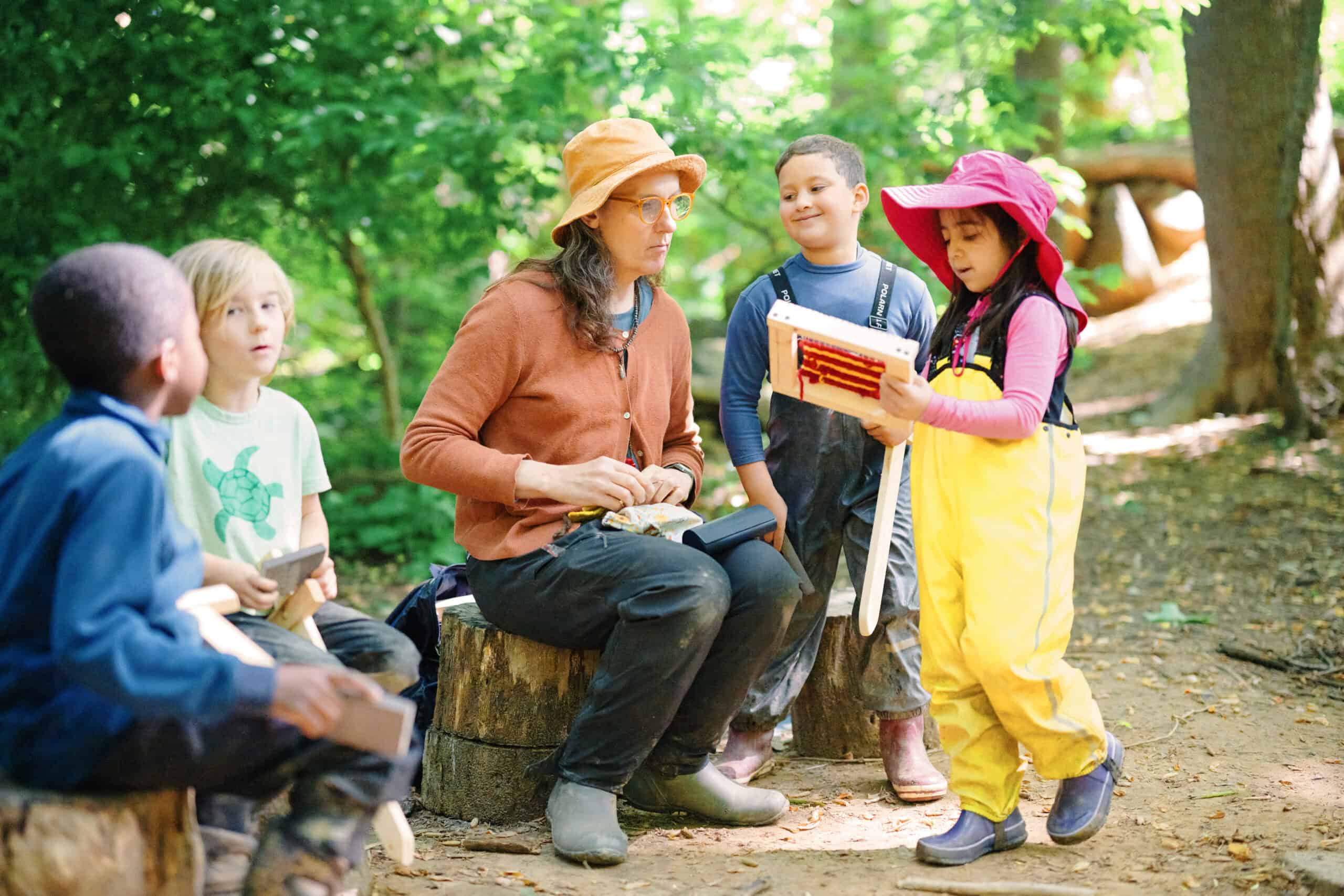
“The children will spot things in the forest that I don’t even see, their ability for observation, noticing details, and living in wonder has exponentially increased since the class started.”
Linc Kinnicutt, Head Teacher for Waldorf in the Woods
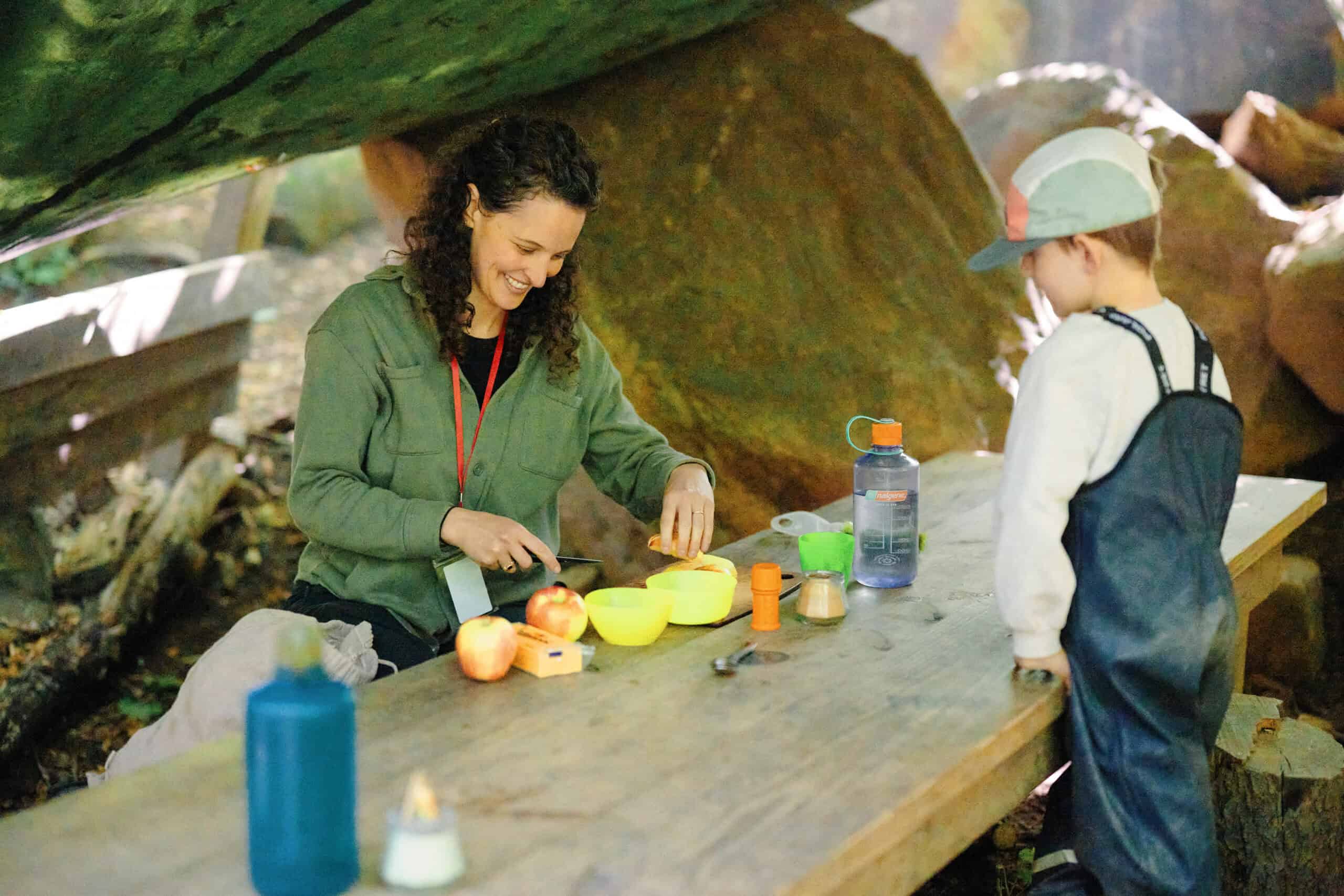
After they reach their home base, they participate in a “circle time” session, during which they sing and move. Later in the day, they’ll snack and hear a story. But most class time is dedicated to supervised — yet self-directed — free play.
Some children explore; others whittle sticks, create wreaths with vines found in the forest, make yarn crafts, or build a structure, such as a little house made out of stones or a stove constructed from logs. They’ve even set big pieces of bark afloat to make a harbor.
“There hasn’t been a single day where children haven’t been able to immediately immerse themselves in imaginative play,” Kinnicutt says. “It’s been incredible to see how the forest nourishes that.”
In most weather conditions the class remains outside, so the school advises parents on the best clothing and outdoor gear for their children. In extreme conditions such as lightning, however, the class moves indoors.
Kinnicutt says the youngsters don’t seem bothered by cold or wet conditions, recalling a day with torrential downpours - “The children were just happy being out in the rain.”
An Ongoing Commitment
The Washington Waldorf School is committed to maintaining the outdoor learning approach for other grade levels as well. The early grades include some time outdoors every day as well as frequent walks along the Potomac River. In the third grade, students spend a week on an organic farm, helping the farmers in the fields and with animals.
At middle-school age, students participate in wilderness skills programs and camping trips. High-schoolers complete a challenging natural science curriculum and participate in hands-on experiences, such as a weeklong trip to the seaside to study tidal pool organisms, and environmental service in the community.
It’s a natural approach to education that not only enriches students’ learning, but also deepens their connection with the world around them.